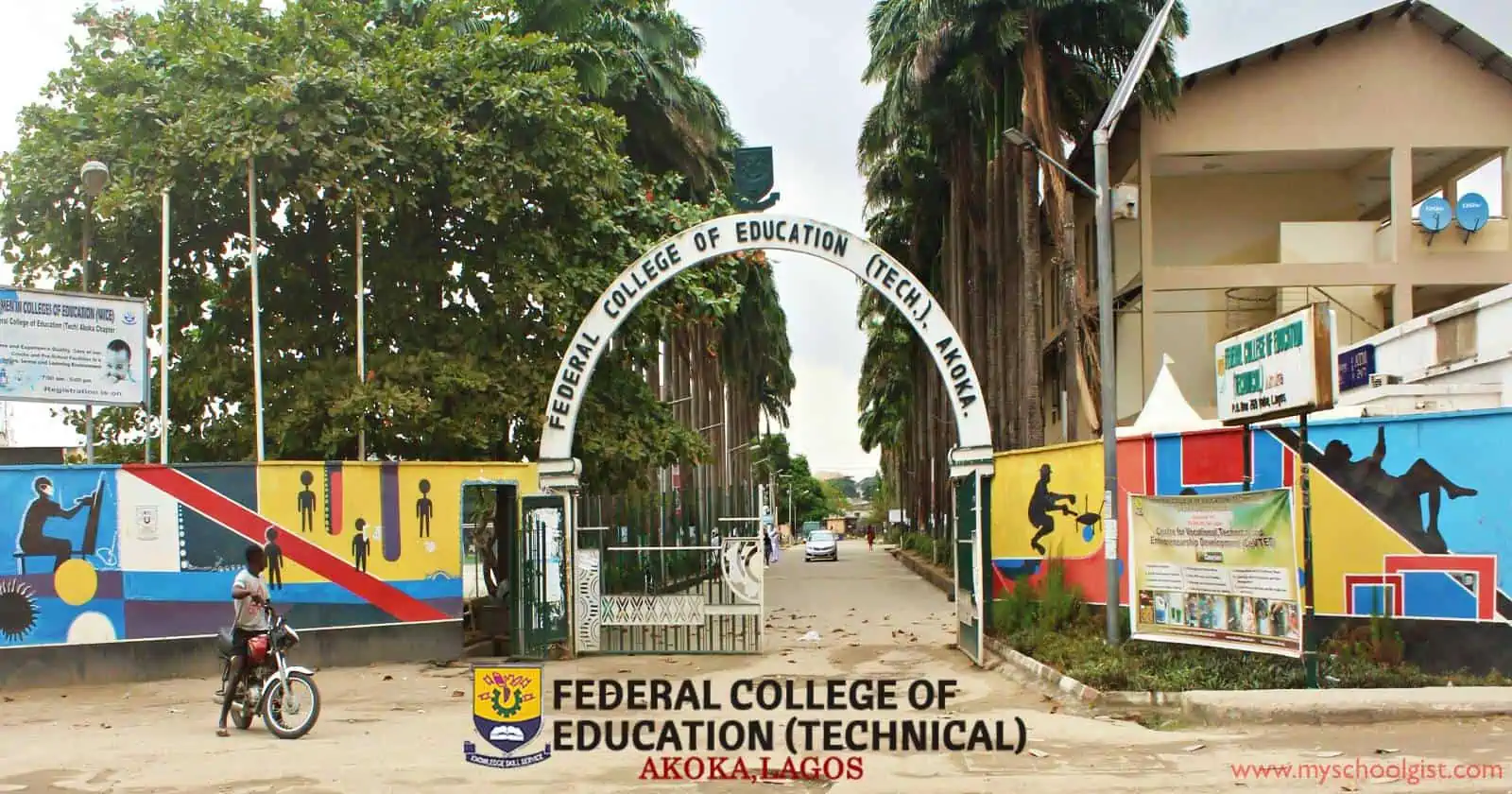
FCE Technical Akoka NCE Programmes, Courses
Walk into most Nigerian secondary schools and technical colleges and you will quickly notice something qualified teachers for technical and vocational subjects are rare. Workshop instructors who genuinely understand electrical installation, building construction, or mechanical systems are even rarer. This is precisely the gap that the Federal College of Education (Technical) Akoka was designed to fill. Located in Akoka, Lagos the same area that houses Yaba College of Technology and sits adjacent to the University of Lagos FCE(T) Akoka occupies a unique and critical niche in Nigeria’s teacher education ecosystem.
Unlike conventional colleges of education that train teachers for academic subjects like Mathematics, English, and Biology, FCE(T) Akoka specifically trains teachers for technical, vocational, and technology-based subjects. The graduates it produces go on to teach in technical colleges, vocational centres, and secondary schools across the country, filling a professional gap that remains significant despite decades of effort to develop technical education in Nigeria.
What Makes FCE(T) Akoka Different From Other Colleges of Education?
The key distinction is in the word “Technical” in the institution’s name. FCE(T) Akoka offers what the education sector calls Technical Teacher Education — a specialised form of NCE training that combines subject-specific technical knowledge with professional pedagogical training. A student at FCE(T) Akoka studying Electrical and Electronics Technology Education is not just learning how electrical systems work; they are learning how to teach those concepts effectively to students in a workshop or classroom environment.
This dual focus technical competence plus teaching methodology is what makes FCE(T) graduates genuinely valuable to the institutions that employ them. A teacher who cannot demonstrate what they are teaching in a practical workshop is of limited use in a technical school. FCE(T) Akoka graduates can both explain and demonstrate, which is exactly what technical education requires.
NCE Programmes Offered at FCE(T) Akoka
The programmes at FCE(T) Akoka are organised around technical and vocational subject areas. Each programme leads to an NCE in Technical Education specialising in the relevant subject area. The main programmes include:
- Electrical and Electronics Technology Education — Trains teachers to handle electrical installation, electronics, and power systems topics in technical colleges and secondary schools.
- Mechanical Engineering Technology Education — Covers engine systems, machine tools, fabrication, and mechanical maintenance, preparing graduates to teach in auto mechanics and engineering workshops.
- Building Technology Education — Prepares teachers to handle bricklaying, carpentry, painting and decoration, and construction-related topics at the technical education level.
- Woodwork Technology Education — Focuses on furniture making, joinery, and wood processing, training graduates to teach in woodwork workshops.
- Metal Work Education — Covers welding, fabrication, and metal processing, training teachers for metalwork workshops in technical schools.
- Computer Education — Prepares teachers to deliver computer science and information technology lessons in secondary and technical schools.
- Home Economics Education — Trains teachers for food and nutrition, clothing and textiles, and home management subjects at primary and junior secondary levels.
- Agricultural Science Education — Covers crop science, animal husbandry, and agricultural technology, training graduates to teach agriculture in secondary schools.
Admission Requirements at FCE(T) Akoka
Admission into FCE(T) Akoka follows the standard college of education admission framework regulated by the National Commission for Colleges of Education. Candidates must sit for JAMB and choose FCE(T) Akoka as their institution. The minimum cut off for NCE programmes in technical colleges of education follows the NCCE-approved threshold which JAMB implements.
O’Level requirements vary by programme. For technical programmes like Electrical and Electronics Technology Education, candidates must have O’Level credits in relevant technical or science subjects including Mathematics and Physics. For Home Economics Education, credits in Biology and Chemistry or Food and Nutrition are relevant. English Language is compulsory across all programmes.
Candidates who have trade skills or technical training from a vocational centre may have an advantage in technical programmes as the practical orientation of the NCE at FCE(T) Akoka means that students who already have hands-on exposure in a relevant trade adapt more quickly to the programme demands.
Direct Entry admission is available for candidates who hold relevant qualifications. Trade test certificates, OND in a related technical field, and A’Level passes in relevant subjects may qualify candidates for 200 level Direct Entry. Prospective students should check the current Direct Entry requirements directly from the college’s official communications.
The NCE Technical Programme Structure
The NCE Technical programme at FCE(T) Akoka runs over three academic years. The curriculum balances workshop-based practical training with theoretical subject knowledge and professional education studies. Students spend significant time in workshops learning and practising the technical skills they will eventually teach. They also take courses in educational psychology, curriculum and instruction, classroom management, and the history and philosophy of technical education.
The Teaching Practice period is a critical component of the programme. Students are placed in technical colleges, secondary schools with technical departments, or vocational training centres where they teach actual lessons under supervision. This experience bridges the gap between academic preparation and professional teaching reality in a way that no classroom-only programme can achieve.
School Fees at FCE(T) Akoka
As a federal institution, FCE(T) Akoka school fees are regulated and generally more affordable than fees at state and private institutions. The fee schedule is updated periodically and the current rates are available through the college’s administrative office and official communications. The federal government subsidy that applies to all federal colleges of education keeps fees within a range that most students and their families can manage.
In addition to tuition, students pay for registration, laboratory and workshop usage, student union levies, and other institutional charges. The Teaching Practice period carries its own associated costs including transportation to placement schools and the preparation of teaching materials and lesson plan documentation.
Career Opportunities for FCE(T) Akoka Graduates
The employment landscape for technical teacher education graduates is genuinely promising. The persistent shortage of qualified technical teachers in Nigerian schools means that FCE(T) graduates face less competition for teaching positions than graduates of conventional academic teacher education programmes. Federal and state technical colleges, vocational training centres, and secondary schools with technical departments are all active employers of NCE Technical graduates.
Beyond teaching, FCE(T) graduates who have strong technical skills often find opportunities in industry as technicians, supervisors, and workshop managers, particularly in smaller companies and workshops that value practical expertise over paper credentials. The dual competence of technical skill and teaching ability makes FCE(T) graduates versatile in a way that specialists from only one side of that combination are not.
Graduates who wish to further their education can proceed to degree programmes in Technical Education at universities. Institutions like the Federal University of Technology Akure, University of Nigeria Nsukka, and several others offer Bachelor of Technology Education degrees that accept NCE Technical holders through Direct Entry. A degree in Technical Education opens pathways to lecturing in colleges of education, research in vocational education, and senior roles in curriculum development within state and federal education ministries.
Student Life and Learning Environment at FCE(T) Akoka
Life at the Federal College of Education (Technical) Akoka is shaped as much by hands-on training as it is by traditional classroom learning. Unlike conventional colleges of education where lecture halls dominate the academic experience, FCE(T) places heavy emphasis on workshops, laboratories, and practical spaces where students actively build, repair, and experiment.
Students in programmes like Electrical, Mechanical, and Building Technology spend a significant portion of their time in well-structured workshop sessions. These sessions are not optional add-ons they are central to the training model. Learning how to wire a building, operate machine tools, or fabricate metal components is treated with the same importance as passing written examinations.
Because of its location in Akoka, Lagos, the college benefits from proximity to major institutions like the University of Lagos and Yaba College of Technology. This creates a broader academic environment where students are exposed to a mix of university, polytechnic, and technical education cultures. It also means better access to libraries, technical markets, and industrial areas where students can source materials and gain informal learning exposure.
Student life also includes participation in departmental associations, technical clubs, and student union activities. For technical students, peer collaboration is particularly important — many projects require teamwork, whether it is constructing a model, wiring a circuit, or completing a fabrication task. These collaborative experiences mirror real-world workshop and industry environments.
Accommodation is available both on-campus and off-campus, with many students choosing to live in nearby areas within the Akoka–Yaba axis. While Lagos presents the usual challenges of cost of living and transportation, it also offers opportunities for part-time technical work, apprenticeships, and exposure to real industry practices that students in quieter towns may not easily access.
For a technical education student, this environment is more than just a place to study — it is a training ground that blends academic learning with real-world skill development, preparing graduates not just to teach, but to demonstrate and lead in practical settings.
FCE(T) Akoka and the Future of Technical Education
Nigeria’s ongoing push to develop its technical and vocational education sector through initiatives like the Technical and Vocational Education and Training framework means that the demand for qualified technical teachers is likely to grow rather than diminish in the years ahead. FCE(T) Akoka graduates are positioned to benefit from this trend. An institution that has been training technical teachers since its establishment is well-placed to continue producing the professionals that this expanding sector needs.
For candidates who have both a love of technical subjects and an interest in education, FCE(T) Akoka offers a career path that is not just professionally viable but genuinely meaningful — contributing to the development of the skilled workforce that Nigeria’s economic transformation depends on.