Korean Government Scholarship 2026 (GKS) – How to Apply, Eligibility, and What It Covers
South Korea Is Funding Over 2,000 International Students Every Year and Most People Outside Asia Have Never Heard of It
There is a pattern in the way students from Nigeria, Ghana, Ethiopia, Kenya, and other African countries approach international scholarships. The search always starts with Chevening. Then Fulbright. Then DAAD. Then Commonwealth. By the time the list is exhausted, most applicants have either found a match or given up.
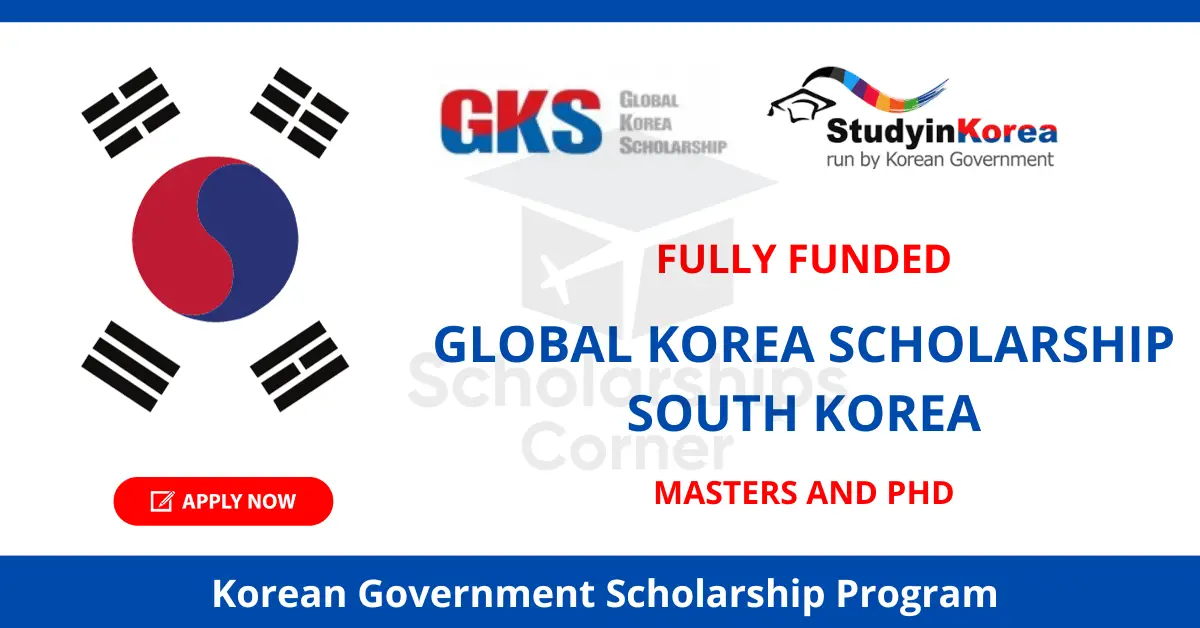
South Korea never enters the conversation. And that is a problem, because the Korean Government Scholarship 2026, officially called the Global Korea Scholarship or GKS, is one of the most generously funded, most broadly accessible, and least competed-for government scholarship programmes available to international students from developing countries today.
The Korean government funds over 2,000 fully paid places annually for international graduate students, over 500 places for undergraduates, and does this through universities that rank among Asia’s best, including Seoul National University, KAIST, Yonsei University, and Korea University. The scholarship covers everything from tuition to airfare to Korean language training, and it is genuinely open to applicants from most African countries.
The reason it stays under the radar for most African students is simply that no one talks about it. That changes now.
What the Global Korea Scholarship (GKS) Covers in 2026
Let us start with the numbers because they matter. The GKS scholarship for international students in 2026 is one of the most financially complete awards available from any government anywhere.
Full financial package includes:
- Round-trip economy class airfare: From your home country to South Korea at the start of your programme and back at the end
- Settlement allowance: A one-time payment of 200,000 KRW (approximately USD 150) when you first arrive in Korea to cover initial expenses
- Monthly living allowance:
- Master’s students: 900,000 KRW per month (approximately USD 680)
- PhD students: 1,000,000 KRW per month (approximately USD 755)
- Research students: 900,000 KRW per month
- Full tuition fees: Paid directly to your Korean university for the entire duration of your programme
- Korean language training: One full year of free Korean language instruction before your degree programme begins, funded entirely by the scholarship
- Research allowance: 210,000 to 240,000 KRW per month depending on your level, to cover academic research expenses
- Medical insurance: Full health coverage for the duration of your studies
- Dissertation printing costs: Covered by the scholarship
- Returning allowance: A payment when you return to your home country at the end of your scholarship
The total value of a two-year GKS master’s scholarship, including tuition, stipends, airfare, and allowances, easily exceeds USD 40,000 to 50,000. This is genuinely competitive with the Commonwealth Scholarship and in some respects more comprehensive, given that the language training year is fully funded on top of the degree.
GKS Scholarship 2026: Who Can Apply and Eligibility Requirements
The eligibility requirements for the KGSP 2026 are clear and more inclusive than most Western scholarships:
Citizenship Requirements
Both the applicant and both of their parents must hold non-Korean citizenship. Applicants with Korean heritage who hold another nationality are eligible only if neither parent is a Korean citizen. This requirement exists to ensure the programme benefits genuinely international students rather than overseas Koreans returning to study.
Age Requirements
For the Global Korea Scholarship graduate programme in 2026:
- Master’s degree applicants: under 40 years old
- PhD applicants: under 40 years old
- Professor applicants: under 45 years old
For undergraduate GKS applicants:
- Must be under 25 years old at the time of application
Academic Requirements
You must have achieved an average GPA of at least 80% in your most recent academic programme, or be in the top 20% of your graduating class. If your transcript does not show a percentage, the scholarship body converts your grade using a standardised equivalency table.
Health
You must be in good physical and mental health. A medical examination is required as part of the application documentation.
Previous Korea Study
Applicants who have already completed a degree in South Korea, or who are current GKS scholars, are generally not eligible to apply again. Former GKS scholars with an overall grade of 90% or above may reapply once.
Korean Government Scholarship 2026: The Two Application Tracks
One of the most important things to understand about the GKS application is that there are two separate tracks, each with its own process, timeline, and competitive dynamics.
Embassy Track
In the Embassy Track, you apply through the Korean Embassy or Consulate in your home country. The Embassy reviews applications, conducts local screening, and nominates a shortlist of candidates to the National Institute for International Education (NIIED) in Seoul for final selection.
How to apply via Embassy Track:
- Contact the Korean Embassy or Consulate in your country and ask about the GKS Graduate application timeline for 2026
- Obtain the official GKS application guidelines from the Embassy or from the Study in Korea website at studyinkorea.go.kr
- Complete the online application form and prepare all required documents
- Submit your application to the Embassy by their local deadline
- Attend a local interview if shortlisted
- If nominated by the Embassy, your application proceeds to NIIED for final screening and university placement
Key advantage of the Embassy Track: You compete only against other applicants from your country, not against the global pool. This means the number of competitors you face directly is significantly smaller. Countries with Korean Embassy allocations in Africa include Nigeria, Ghana, Kenya, Ethiopia, South Africa, Egypt, and many others.
University Track
In the University Track, you apply directly to a specific Korean university that participates in the GKS programme. The university conducts its own screening and nominates selected candidates to NIIED.
How to apply via University Track:
- Research Korean universities on the official GKS participating university list
- Identify a university whose programme and research focus matches your academic goals
- Contact the university’s graduate admissions office and confirm they are accepting GKS University Track applications
- Submit your application directly to the university
- If nominated by the university, NIIED conducts final selection
Key advantage of the University Track: You can target a specific university with a specific professor or research group whose work aligns with yours. A university that actively wants you as a researcher will fight harder for your nomination. If you have already made contact with a Korean professor interested in your work, the University Track is almost always the stronger option.
Korean Government Scholarship 2026: Universities That Accept International Students
Over 80 Korean universities participate in the GKS programme. The quality range is wide, from globally ranked research universities to strong regional institutions. Here are some of the most significant:
Seoul National University (SNU)
The flagship national university of South Korea and consistently ranked among the top 40 universities in the world. Seoul National University has a dedicated GKS programme and is one of the most sought-after placements for international scholars. Programmes across engineering, social sciences, natural sciences, medicine, and the humanities are available.
KAIST (Korea Advanced Institute of Science and Technology)
KAIST is South Korea’s MIT equivalent. It is one of Asia’s top science and technology universities and a powerhouse in engineering, computer science, and applied sciences. All graduate programmes at KAIST are conducted in English, removing the Korean language barrier for STEM applicants.
Yonsei University
One of South Korea’s most prestigious private universities, located in Seoul. Yonsei is strong across business, international relations, medicine, and the humanities. It has one of the largest international student communities in Korea.
Korea University
Another member of South Korea’s SKY university trio (Seoul National, Korea, Yonsei), Korea University offers world-class programmes across all disciplines and has active international student programmes.
Sungkyunkwan University (SKKU)
Founded in 1398, SKKU is one of the oldest universities in Asia. It has strong Samsung-linked engineering and business programmes and is particularly well funded for research.
Fields of Study Available Under the GKS Graduate Scholarship
The Korean government scholarship for masters and PhD students covers a wide range of academic disciplines:
- Engineering and technology (electrical, mechanical, chemical, civil, computer)
- Natural sciences and mathematics
- Humanities and social sciences
- Business administration and economics
- International relations and political science
- Public health and medicine (non-clinical research)
- Agriculture and environmental sciences
- Korean language, literature, and culture
- Arts and design
- Industrial sciences related to Korean economic priorities
Applicants in STEM fields tend to have the widest access to University Track opportunities, particularly at institutions like KAIST and POSTECH, where English-taught programmes are standard and Korean language proficiency is less critical during the degree.
The Korean Language Requirement: What It Means in Practice
One of the most common reasons African students rule out South Korea as a scholarship destination is the assumption that Korean language proficiency is required. The reality is more practical than most people realise.
For applicants without Korean language skills: The GKS scholarship includes a one-year Korean language training course before your degree programme begins. This training is fully funded, structured, and conducted at a Korean language institute. By the time your academic degree starts, you have a foundational level of Korean.
For programmes taught in English: Institutions like KAIST, several programmes at Yonsei, and specific departments at other universities deliver their graduate programmes entirely in English. For these, Korean language training is supplementary rather than essential for academic survival.
TOPIK requirement: By the end of the language training year, scholars are expected to achieve a minimum of TOPIK Level 3 to enter their degree programme. If a scholar does not reach this level, their entry into the academic programme may be delayed. This is a real requirement, not a formality, so taking the language training seriously from the start matters.
How to Write a Strong GKS Study Plan
The study plan is the most critical written document in your GKS application. Korean scholarship reviewers expect it to be academic in tone, specific in content, and clearly connected to Korean research capacity.
A strong study plan for the Korean government scholarship application in 2026 should address:
- Your academic background and the research skills you bring
- The specific research question or academic focus you want to pursue
- Why South Korea and specifically your target university is the right environment for this work
- Reference to a specific Korean professor, research group, or laboratory whose work connects to yours
- What you intend to contribute to Korean academic institutions and to your home country through your studies
- Your plans after graduating and how the Korean degree enables them
Generic study plans that could apply to any university in any country are the most common reason otherwise strong GKS applications fail. Specificity about Korea, about your target institution, and about the actual academic work you plan to do is what separates winners from unsuccessful candidates.
GKS Scholarship 2026 Deadlines and Application Timeline
Timelines vary by country and track, but the general framework for the GKS graduate scholarship 2026 is:
- Embassy Track application period: Typically February to March 2026 at most Korean embassies globally
- University Track application period: Usually runs in parallel, typically February to March 2026, with individual universities setting their own precise deadlines
- NIIED final screening: April to May 2026
- Result announcement: Around June 2026
- Korean language training begins: September 2026
- Academic degree programme begins: September 2027 (following one year of language training)
Check the Korean Embassy in your country’s website and the Study in Korea portal (studyinkorea.go.kr) for the precise dates applicable to your country.
GKS Scholarship for African Students: Country Allocations
The Korean government allocates GKS places by country. For African countries, Embassy Track allocations exist for:
Nigeria, Ghana, Kenya, Ethiopia, South Africa, Tanzania, Uganda, Cameroon, Rwanda, Senegal, Ivory Coast, Tunisia, Morocco, Egypt, and several others. The number of slots per country varies from 1 to 10+ depending on the bilateral relationship between that country and South Korea.
If your country’s Embassy allocation is small (for example 2 or 3 places), competition is tight at the local level. In that case, the University Track offers an additional pathway where you compete for a place directly with the target university rather than through the Embassy quota.
Frequently Asked Questions About the Korean Government Scholarship 2026
Is the GKS scholarship fully funded?
Yes. The Global Korea Scholarship covers full tuition, monthly living allowance, airfare, medical insurance, research allowance, Korean language training, and settlement and return allowances. It is one of the most comprehensively funded government scholarships available to international students.
Can African students apply for the Korean Government Scholarship?
Yes. Students from most African countries are eligible through their country’s Korean Embassy Track. Several African countries including Nigeria, Ghana, Kenya, and Ethiopia have dedicated Embassy allocations for GKS.
Do I need to speak Korean to apply for GKS 2026?
No. Korean language training is included in the scholarship as a one-year preparatory course before your degree begins. Existing Korean language proficiency is beneficial but not a requirement at the application stage. Applicants to English-taught programmes at KAIST and certain other universities face even less language pressure.
Which is better: Embassy Track or University Track for GKS?
If you have a strong academic relationship with a specific Korean professor or research group, University Track gives you a direct, targeted application pathway and can be more effective. If you do not have existing university contacts, Embassy Track is the standard route. Applying to both simultaneously (which is not permitted) is not possible, so you must choose one per application cycle.
What GPA do you need for the Korean Government Scholarship?
A minimum of 80% average in your most recent degree programme, or a ranking in the top 20% of your graduating class, is required. Strong applicants who win GKS typically have academic records well above the minimum.
How many GKS scholarships are available in 2026?
The Korean government awards over 2,200 graduate GKS scholarships annually to students from over 153 countries. An additional 500+ undergraduate places are available. The total intake makes GKS one of the largest fully funded scholarship programmes from any single government.
South Korea Is Waiting for Your Application. Most of Your Competitors Have Not Even Found the Programme Yet
The information asymmetry around the GKS scholarship is your advantage. While thousands of applicants from Africa are sending the same applications to Chevening and Fulbright, a far smaller group is applying for the same number of Korean scholarship places, often through an Embassy quota of five or six spots for an entire country.
Prepare your study plan specifically. Research your target university and professor. Submit through the Embassy or University Track before the February deadline.
Most people will not do this. That is precisely why you should.